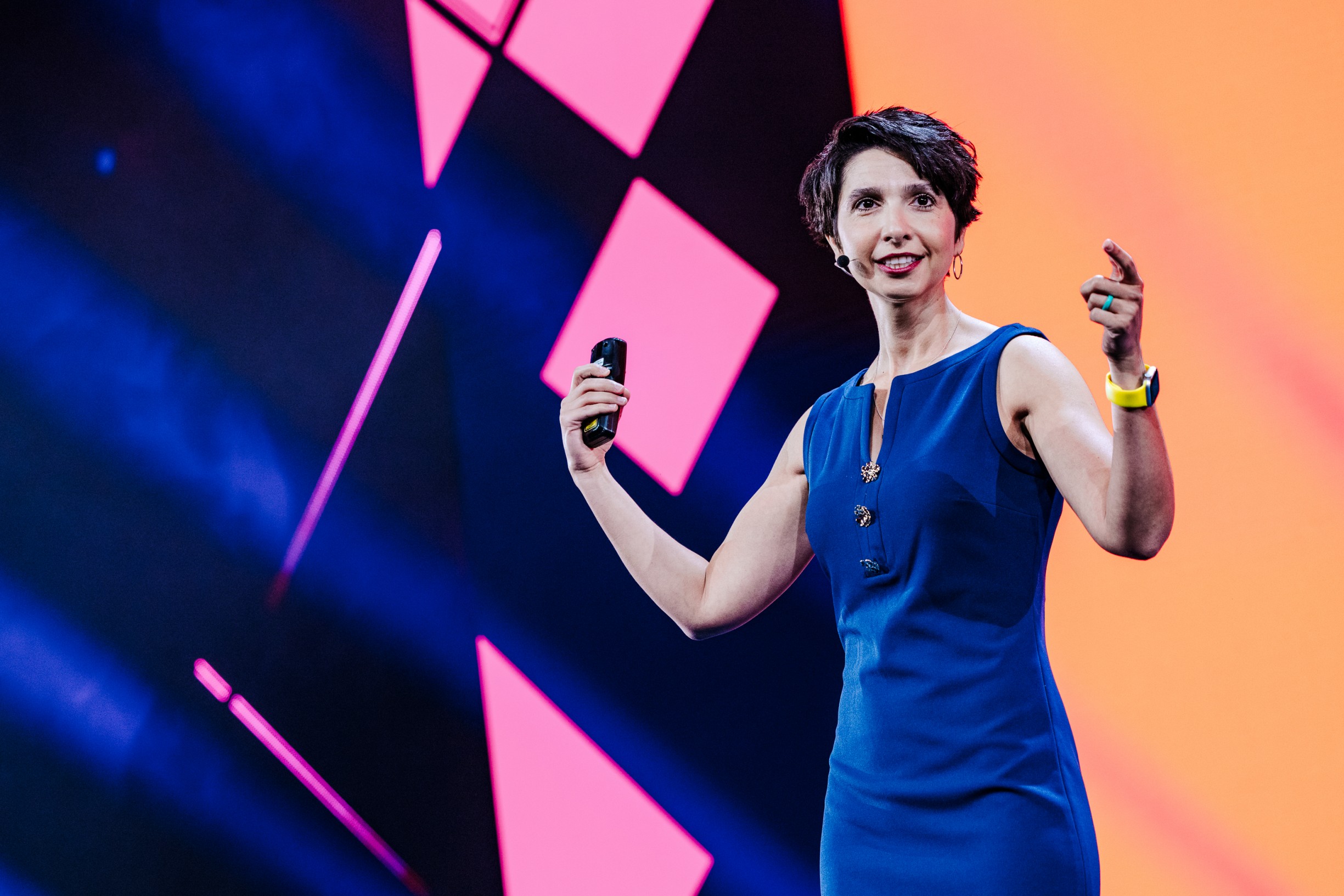
The better you get at your job, the less you question how you do it. At Amsterdam Business Forum 2026, serial entrepreneur Diana Kander showed why that is the biggest threat to your growth.
“The more successful you become, the bigger of an expert you get at your job, the less you question how to do it better.”
Diana Kander was eight when her family escaped the Soviet Union in 1989, against her grandmother’s wishes. It taught Diana an early lesson: “The status quo has this strong gravitational pull.” Today she is a lawyer, a New York Times bestselling author, and the founder of ten companies.
In Block 1, about the role of humans in AI-driven organizations, she shares three of “the most human questions” to escape that pull: What are my zombies? What can I reimagine? Who should be on my pit crew? We explain them in 5 insights, with 5 concrete lessons for you.

Insight 1: Your success is your biggest brake
“How fast are you innovating on a scale of Snoop to Vanilla Ice?”
Diana plays a game: name that singer. First up: Snoop Dogg. In the last year alone, he started a jewelry company, became co-owner of a Welsh soccer club, and opened a bar with Dr. Dre. Next: Vanilla Ice. The room goes quiet. He flips houses. And he still sings that one song at state fairs. Once, he sold more records than Snoop.
So what slows our growth? The audience guesses overthinking, fear, and avoidance. Diana’s first answer, after a decade of research: our children. Kidding. “It’s our own success. Because once we find a way of working, we just kind of lock it in and try to be as efficient as possible at what we know how to do.” Curiosity needs space, and our days are full of emails, to-do lists, and fires.
Concrete lesson for you: Rate yourself honestly on the scale from Snoop to Vanilla Ice.
Insight 2: Ask what to stop
“The more innovative question to ask is, what should we stop?”
Put every project, call, and meeting on a map of value versus effort. Everything that costs more than it brings is what Diana calls a zombie. The project with no plan B. The rule made by someone who left long ago. The meeting with too many people, no agenda, that should have been an email. “Not every hour of your day is created equal.”
Take the X-ray. Shoe stores used it to check if shoes fit. Doctors used it on pregnant women. In 1958, Alice Stewart showed that their babies died of cancer soon after birth. Still hospitals took 25 years to stop. “I’m not here to tell you to do less,” Diana says. “I want you to do more of what matters.”
Concrete lesson for you: Plan one meeting with a single agenda item: “What should we stop?”
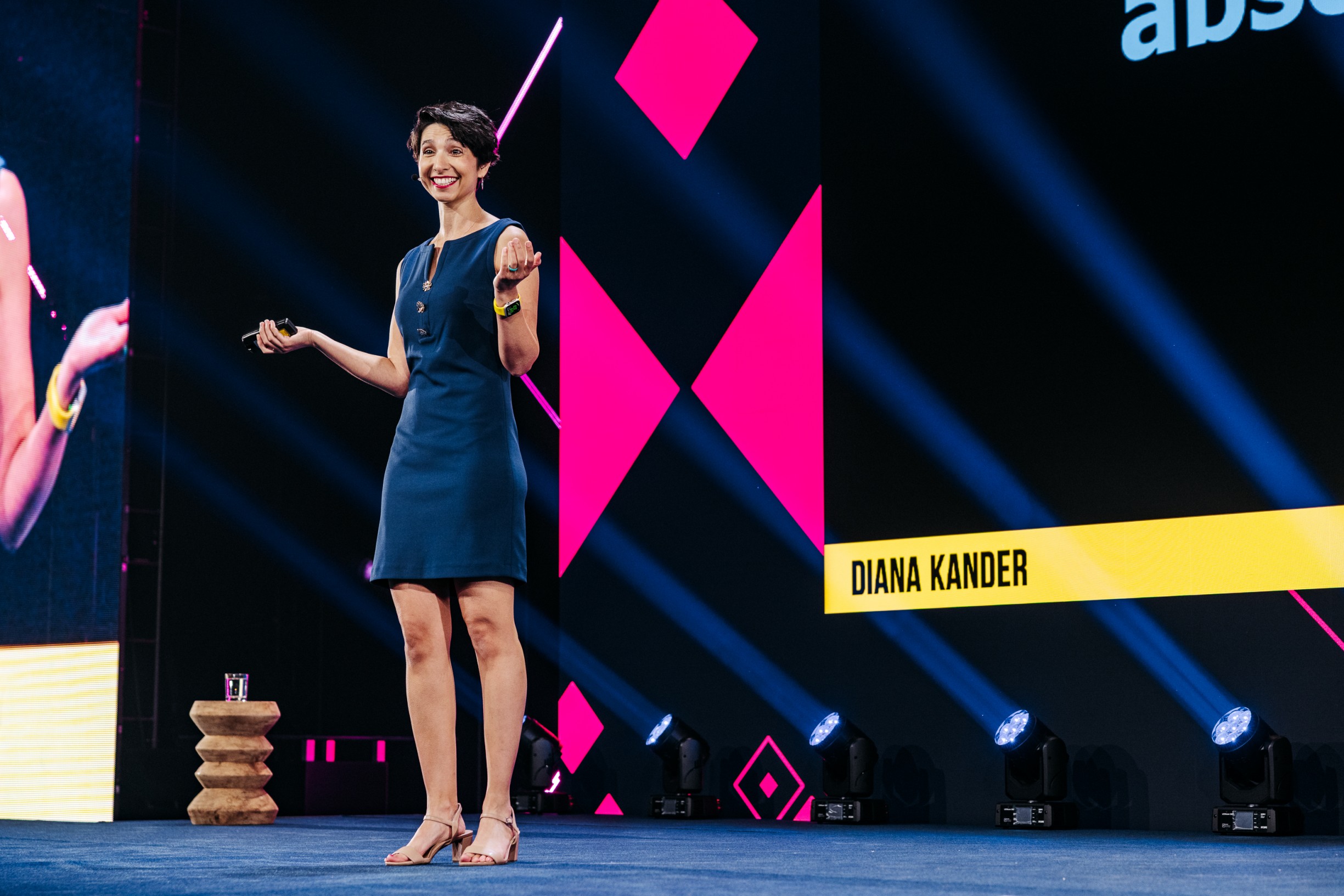
Insight 3: Reimagine from a blank sheet
“The things that are serving us today are also preventing us from what’s possible for us in the future.”
Diana learned this in her first business. Year one: $77,000 in revenue. She wanted into Kansas City’s only business accelerator, built for fast-growing tech companies. Her pitch: let me learn from you, and I’ll make $100,000 next year. The director: “I don’t care about $100,000.” She could join if she made a million. Laughing: “That’s super reasonable. I’ll do that.”
Then the panic. In a cubicle where he couldn’t see her, she added up everything she did in year one. Even working 18-hour days: maybe $150,000. So she flipped the paper over, wrote a million dollars at the top, and sketched a new business. She made $870,000, then millions after that, “because I stopped doing everything that had worked for me in the first year.”
Her biggest enemy has a name: Saly. Accountants use it for “same as last year.” “Saly just pretends to be your best friend,” Diana warns. “Let’s grab a blanket and a glass of wine and watch some Netflix. And that is exactly when we start to fall behind.”
Now that people open emails wondering is this written by AI?, she makes it more human. Her booking form asks for your favorite comedian. Twenty minutes into a Zoom call, she pulls out a mug with the client’s logo. “If we’re trying to be human in our communication, then wouldn’t it make sense for us to show more of our humanity?”
Concrete lesson for you: Pick one process a year and redesign it from a blank sheet. Start with the moments where customers meet you.
Insight 4: Build a pit crew
“I actually don’t think you can think outside the box. I think you need another human being to pull you out of it.”
For almost a decade, Great Ormond Street Hospital in the UK couldn’t solve one problem: children survived heart surgery, then died during the handoff to the ICU. Then two surgeons watched a Formula One race on TV and wondered if a pit crew could help. Staff hated the idea. “These people are mechanics.” The Ferrari pit crew came anyway. Their verdict: people unplugging equipment across each other, shouting directions, nobody in charge, no fixed order. The result: 66 percent fewer errors, and a new standard for children’s hospitals worldwide.
Concrete lesson for you: Invite an outsider to watch your team work on the problem you can’t crack.

Insight 5: Never goal alone
“If you’re the kind of person that addresses a problem with a to-do list, I just want the first three bullets of that list to be the names of people.”
Diana coined the phrase “never goal alone,” and she tested it on herself. Over 40, she set out to do a single pull-up. She found 35 women on Instagram who wanted the same thing. And she recruited Misty Posey of the US Marine Corps, who wrote her master’s thesis on how women in the Marine Corps should do pull-ups.
Then came breast cancer. Her instinct was the one she had relied on since arriving in the US as a refugee: handle it alone. This time, she let people in. They walked her dog, brought food, and took care of her children. The day before surgery, she did ten pull-ups. Yet that wasn’t the strongest thing she did that year. “It was allowing other people to be on the journey with me.”
Concrete lesson for you: Next time you write a to-do list for something hard, make the first three items names, not tasks. One person to think it through with, one for a different perspective, one to hold you to it.
Growth is a choice
Diana ends with a gymnastics vault: the gold medal jump from 1956. Nobody in the room is impressed. Everybody knows Simone Biles. The danger is thinking today’s best is as good as it gets. And without realizing it, we all assume we grow along with the world around us. Let Vanilla Ice be your daily reminder that we don’t. Growth is a choice.
Five questions for reflection
Ready to choose growth? Start here.
- Which habit that made you successful might now be holding your team back?
- Which zombie does everyone in your organization see, yet nobody stops?
- Who outside your field could look at your hardest problem?
- What would you stop tomorrow if nobody objected?
- Snoop or Vanilla Ice: which are you?